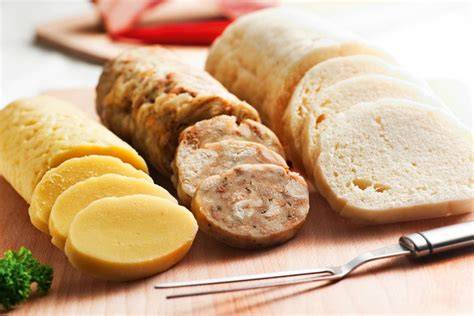
Dumplings are an essential part of Czech cuisine.
A dumpling or in Czech knedlík (plural knedlíky) and regionally also šiška (plural šišky) is a dish made from dough and boiled or steamed.
Knedlíky are traditional Czech dumplings which use a dough similar to bread dough.
They're boiled and sliced, and served with a variety of traditional Czech dishes.
There are many different ways to make traditional Czech dumplings, or knedlíky.
Czech cuisine is considerably humble, with influences from surrounding countries.
Much of Czech cuisine consists of comforting recipes for soups, stews, and meat dishes (namely pork, beef, and poultry including game birds).
Postavení knedlíků v české kuchyni
Served as side dish, dessert or main course.
Dumplings accompany several famous Czech dishes such as svíčková na smetaně, rajská or roasted duck with cabbage.
They are the ideal side dish for sauces.
As a side dish, we usually eat Czech dumplings, potato dumplings, pasta or boiled potatoes.
It is also possible to choose a sweet variant for lunch in the form of sweet dumplings.
Sweet dumplings are a main course in the Czech cuisine.
Bohemians, Moravians and Silesians have always known how to utilize the few ingredients they had to make the best from them.
And so taking some fruit and wrapping it in yeast dough, cheese-dough or any other dough you like will give for a delicious meal you’ll want to repeat.
That means fruit dumplings, and it is the number one sweet lunch here!
These dumplings are filled with fruit such as strawberries, apricots, blueberries, plumbs, or raspberries.
As a topping, we add quark cheese, poppy seeds or breadcrumbs.
Základní druhy a jejich použití
If you’re a beginner in cooking Czech we recommend starting with Yeast Bread Dumpling (kynutý houskový knedlík), which is delicious and you can whip it up with minimum effort.
If you want a more sophisticated version that not only tastes great but also looks amazing, go for the Carlsbad Dumpling (karlovarský knedlík).
With just a few more ingredients it will give your dish a hint of nutmeg and parsley.
In Czech cuisine it’s mainly the case of the potato dumpling.
The first way to make a side dish potato dumpling into the main course is to stuff it, typically with smoked meat or spinach.
An easier way is to change the shape of the dumpling completely.
Potato dumplings cut into thin pieces are called šišky or šlejšky and they are served mixed with all the delicious things that the stuffed dumplings are stuffed with.
So typically smoked meat and fried onion or spinach and fried onion.
Dumplings in Soup? Liver dumplings are the cherry on top in good Czech beef broth with spring vegetables and noodles.
Slavná česká jídla s knedlíky
It consists of boiled beef, Czech dumplings and root vegetable sauce such as carrot, celery and parsley.
Beef broth, cream and spices are added to the vegetable base.
It is a tomato sauce with typical spice bay leaf and cream.
This dish consists of roast pork, sweet and sour cabbage and classic or potato dumplings.
Vepřo=pork, knedlo= dumpling, zelo= cabbage.
Although “Guláš” (goulash, Gulasch) is not an original Czech dish, it is also very popular in Czech cuisine.
It is eaten with dumplings (how else) or simply with bread.
It is based on onions, pork or beef, ground pepper and flour.
Czech goulash is very rich and heavy.
Venison is also a typical dish in Czech cuisine, as well as some fish.
It is common to go fishing and catch your fish.
Due to the fact that mushroom picking is one of the very local hobbies, this ingredient is very popular in soups or sauces.
Spekový knedlík a houskový knedlík
What is the true gem of Czech cuisine?
If you guessed bread dumplings -Houskové knedlíky - you are absolutely right!
Knedlíky (plural) or knedle are among the most common side dishes in Czech cuisine.
Czech bread dumplings are made from flour, liquid, egg, yeast, salt, and bread cubes.
The dough is shaped into a cylinder, then boiled or steamed.
NOTE: There is another version of bread dumplings known in the Czech Republic, made by using baking powder instead of yeast.
Let's be clear: Today I'm talking about dumplings WITHOUT baking powder.
MY TIP: The Czech Republic is a true dumpling superpower!
So why stop at just the most famous ones?
You might have heard of those so-called Hairy dumplings (Chlupaté knedlíky) made from grated raw potatoes, or the very classic Czech potato dumplings (Bramborové knedlíky) made with boiled potatoes.
But hey, do you prefer sweets?
Ingredience a příprava těsta
You'll need only a few ingredients to make homemade bread dumplings from scratch.
Flour-in the Czech Republic, these dumplings are usually made with Hrubá mouka, a coarsely ground flour that is hard to find abroad.
Milk-you can substitute it with warm water if you want.
Active dry yeast-Czechs use fresh yeast, and so did I in this recipe.
The dumplings will rise even if you use instant yeast, though.
These Czech dumplings use dry active yeast for the recipe.
Instant yeast: reduce the amount of yeast by 25% and mix the yeast directly into the flour mixture.
Fresh yeast: double the amount of yeast and crumble it into your warm milk mixture.
This recipe uses kosher salt (aka cooking salt, kitchen salt, coarse salt outside of the US).
If you are using table salt, you can scale down the salt as that is a saltier type of salt by volume!
Begin by combining the warm milk, sugar, and yeast in a medium mixing bowl.
Let it bloom for about 10 minutes.
Next, combine the flour and salt in a large mixing bowl, stir in the milk and egg mixture, and knead together for a few minutes until smooth.
The dough can be a bit tacky but shouldn't be very sticky.
If it's sticky, add a bit more flour as needed.
Combine the warm milk, sugar, and yeast.
Let it bloom for about 10 minutes.
Beat the egg into the milk mixture.
Combine the flour and salt in a large mixing bowl, stir in the milk and egg mixture, and knead together for a few minutes until smooth.
The dough can be a bit tacky but shouldn't be sticky.
If it's sticky, add a bit more flour as needed.
Cover with a towel and let it rise in a warm spot for 2 hours or until doubled in size.
Cut the dough into thirds, and shape each piece of dough into a 2-inch thick rope.
I like using a digital scale to divide my dough into equal sized pieces, but you can eyeball it if you don't have a scale.
Cover with a towel, and let the shaped dumplings rise for 15 minutes.
Vaření, dušení a podávání
Meanwhile, select a pot that is at least 10-inches wide and deep enough to boil water.
Add water and salt and bring to a boil.
Boil the dumplings uncovered for 20 minutes flipping them over halfway through.
If they don't all fit in your pan at once, cook them in batches.
I cook mine one at a time, so it can be time consuming (a full hour to cook all 3 dumplings) but it's not very hands on.
Set a timer for 10 minutes, then flip.
Set your timer for another 10 minutes, then remove.
Easy peasy.
After removing from the boiling water with a large slotted spoon or spatula, immediately poke them with a toothpick in a few spots to let the steam out.
I find that these dumplings are fine at room temperature for a while before serving them.
Mine have sat out for an hour or longer before I served them with dinner.
Cover them so they don't dry out if you aren't going to serve them immediately.
Steaming is the best way to reheat your Czech dumplings.
Add a little water to a pot and place a steamer basket over the top.
Heat it on high heat, then once you hear the water boiling, lower the heat so it's more of a gentle simmer.
Czech dumplings are soft and slightly chewy with a spongy quality that is great at soaking up sauces and gravies on your plate.
Honestly, I just think of them as spongy bread and would use them as such.
This recipe for Czech dumplings looks and tastes EXACTLY like the knedlíky I enjoyed on my trip to Prague and the Czech Republic.
Pečení, krájení a skladování
To store: cool cooked dumplings completely, wrap them in aluminum foil or plastic wrap, then place in freezer bags into the refrigerator or freezer.
You can refrigerate dumplings for several days, or freeze them for longer (about 3 to 6 months since they are basically bread).
To reheat: thaw dumplings completely (preferably overnight in the refrigerator) and slice them into portions.
Add a little water to a pot and place a steamer basket over the top.
Heat it on high heat, then once you hear the water boiling, lower the heat so it's more of a gentle simmer.
Arrange sliced dumplings on the perforated steamer, cover, and steam for 2 to 3 minutes until heated through.
Wondra flour is a type of quick mixing or instant flour by Gold Medal brand available in the United States.
It is more coarse than regular all-purpose flour.
Here are some alternatives for flours you can try for making these in other countries.
When in doubt, measuring by weight is always preferable to measuring by volume.
The conversion of Wondra flour in this recipe from cups to grams is accurate (both by testing and also confirming the conversion on the Wondra packaging which states that ¼ cup = 30 grams).
If you're measuring by volume and your dumplings turn out dry, you are packing too much flour into your cups.
Tipy k podávání a zbytky
The old-fashioned technique of how Czechs slice knedlíky is using a cotton thread.
You can cut a still warm dumpling roll with a very sharp knife.
Steamed dumplings will always offer the most visually appealing result.
They will be soft and pretty smooth inside, with a regular shape, and not mushy on the surface.
If you choose to boil the dumplings, keep in mind that the boiling water can slightly erode their surface, making them less than perfectly symmetrical and a bit denser inside.
Get a clear visual: On the left is the steamed dumpling, and on the right is the boiled version.
My tip: Want to try steaming dumplings instead of boiling? No fancy steamer needed! A simple steam rack insert works great, or you can stretch a clean cloth over a pot with a little water and cover it-easy and budget-friendly!
What do sliced Knedlíky look like? On the left, you will see slices of steamed dumplings, and on the right, slices of the boiled version.
Your goal should always be to steam the dumplings whenever possible.
The bread dumplings are called the "bread" ones for a reason.
It is because they contain diced white bread.
The best bread for dumplings is white bread with a golden crust.
The white bread must be 2-3 days old and stale, or it falls apart in the dough and will not be recognizable in the finished product.
Knedlíky should contain approximately 10-30% bread cubes.
Any dumpling leftovers in your fridge?
Can I freeze bread dumplings?Yes, it is a common method for storing dumplings.
I recommend spreading the dumplings out in the freezer so they do not touch.
After 30 minutes, transfer them to an airtight container.
This way, the dumplings will freeze individually, allowing you to take exactly the amount you need.
How to thaw dumplings?Remove the dumplings from the freezer and place them in a plastic bag to thaw at room temperature.
To speed up the process, you can put the bagged dumplings in the microwave.
Thawing them in a plastic bag prevents the surface from drying out, ensuring they remain as soft and fresh as when first made.
What pairs best with dumplings?
Bread dumplings go well with iconic Czech sauces, such as svíčková or rajská.
They are also perfect as an accompaniment for Czech goulash (guláš), roasted duck with cabbage, or stew.
Knedlíky leftovers taste great diced and fried with eggs in butter.
Praktický přehled
| Typ | Charakteristika | Použití |
|---|---|---|
| kynutý houskový knedlík | delicious | side dish |
| karlovarský knedlík | more sophisticated version | sauces |
| Bramborové knedlíky | made with boiled potatoes | side dish |
| Chlupaté knedlíky | made from grated raw potatoes | traditional Czech food |
| fruit dumplings | filled with fruit | sweet lunch |